Showing posts with label Emilie Lygren. Show all posts

Tuesday, October 20, 2020

The Poetry of Now: Nature Journaling #10


I’m going back directly to the book that started this journal journey. How to Teach Nature Journaling by John Muir Laws and Emilie Lygren is epic in scope and content. Seriously good stuff. Right in the middle is Poetry of Place and Moment. This lesson was perfect for my needs today.

The weekend came and went for me without even attempting a walk and journaling. It’s Tuesday and I still couldn’t get myself prepared for a big thing, but wanted to do something. It’s gray and cold here. The news is awful. But something short, I could do, so when I flipped to this one, I knew I hit the perfect opportunity. 


Using the powerful exploration phrases of “I notice”, “I wonder”, and “This reminds me”, I could write something that depicts my Now that's right on my patio. The setting need not be fancy. With luck, I could take the next step and connect how I’m feeling inside with that outside.


I donned my coat and took my journal out. I sat for a while without doing anything. I needed to enter the space and that takes time.


My poem simply lists that process. I didn’t worry about it at all. It could benefit greatly from revisions. I could add, delete, edit, tweak. Pfft. It’s content, errors, and weaknesses fit my mood- my Now.


Last week I spent significant time on my visuals. This week, all I got was a shadow of an American goldfinch. And to me, that’s fitting, too. It’s both physically and mentally dark, obscured, and basic in today’s Now. I didn’t add any details to the goldfinch’s posting except its scientific name. I did take a photo of dried blackeyed Susan seed heads as a reminder that perhaps that will be a food source. 


Remember: journaling is never wrong. We are recording our place and moment as best we can.


If done in a class, journalers can share their work in pairs or whole-group but it’s important to give everyone the space they need. Sharing should always be a choice and expectations for audience reactions and feedback must be in place ahead of time. 


Poetry is an especially personal journey. It links one's inside with the outside and that exposes the core.


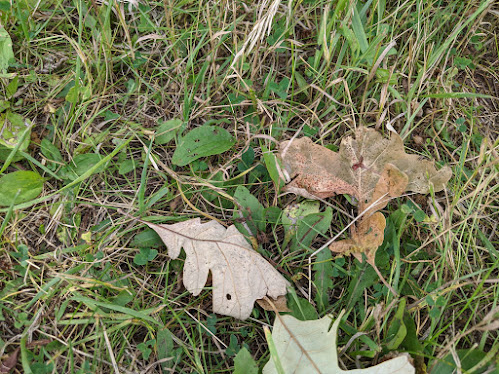
I added a picture of the dry Norway maple leaves and still-green alpine strawberry leaves that were at my feet. The green is a reminder to me that there’s still tenderness and life out there in our Now. 


The work is in becoming aware of it and acknowledging it.


Then, we can step forward to a new moment and place.


Sunday, August 16, 2020

I Notice...Nature Journaling Week 1


It’s always great to try new learning experiences, but in 2020 it makes even more sense. I think there’s a desire for activities that give the greatest bang for your buck, and nature journaling seems ideal.

There are many resources out there, but I’m using John Muir Laws and Emilie Lygren’s How to Teach Nature Journaling: Curiosity, Wonder, Attention as my main one. It’s about $25 and has a full curriculum for the “how-to’s” and incredibly diverse information on why nature journaling is so beneficial to a person’s growth and well-being. In a nutshell, it works regardless of age, ethnicity, abilities, location, or situation.


The authors list these benefits:


  • To slow down, pay attention, and experience awe and wonder

  • To develop students’ creativity and critical thinking skills

  • To develop students’ science identity through authentic science practices

  • To nurture connection with nature

  • To build an inclusive culture of curiosity in the family or classroom

  • To support interdisciplinary learning


In my mind, your supply needs are limited (a writing implement and something to write on) and the subject is immediately available outside your door- it can be anything and everything outside. From an asphalt playground or a single plant to a 300 acre park, there is a nature experience there to have and to document.


You can add some extra tools (something to sit on, something to magnify what you’re looking at, a ruler, thermometers, electronic devices, etc.) but they aren’t necessary.


The Three Parts


Each entry should be a mix of 3 things:


  • PICTURES

  • OBSERVATIONS, IDEAS, AND THINKING

  • NUMBERS


Structure


Different activities may lend themselves to different layouts on the page. However, there’s incredible flexibility and each person’s will be different. Someone who really likes pictures may have to push themselves to write down numbers and words. Someone who loves words and may be nervous about drawing may have to push themselves to sketch. It’s all OK. The important part is to try every time.


Here’s my journal page:

Not much to look at, is it?


For me, that's totally OK. It has what it needs: numbers, observations, and pictures. I didn’t list or describe all the plants I saw nor did I express any larger ideas and thinking. It’s also not pretty by any stretch. But the purpose of this specific event was to begin at step one: “To slow down, pay attention, and experience awe and wonder by observing.” It’s a place to build from.


Here’s how it came into being:


On August 15, I went to the City of Waukesha’s Glacier Cone Park on Madison Avenue. There is street parking and a mowed path up about 145 feet to the top. The park is a glacial kame- basically a huge pile of rock and gravel deposited by the ice that started to melt and retreat about 15,000 years ago during the last Ice Age. A tiny fragment of oak savanna is located at the top and the city seems to be managing the plant life to encourage that along with keeping other woody species at bay.


I was walking pretty determinedly when I began. I told myself to start looking around as I climbed the hill. It was warm, but the breeze was nice. I stopped to notice a washout on the path where you can see the till that the cone-shaped kame is made of.


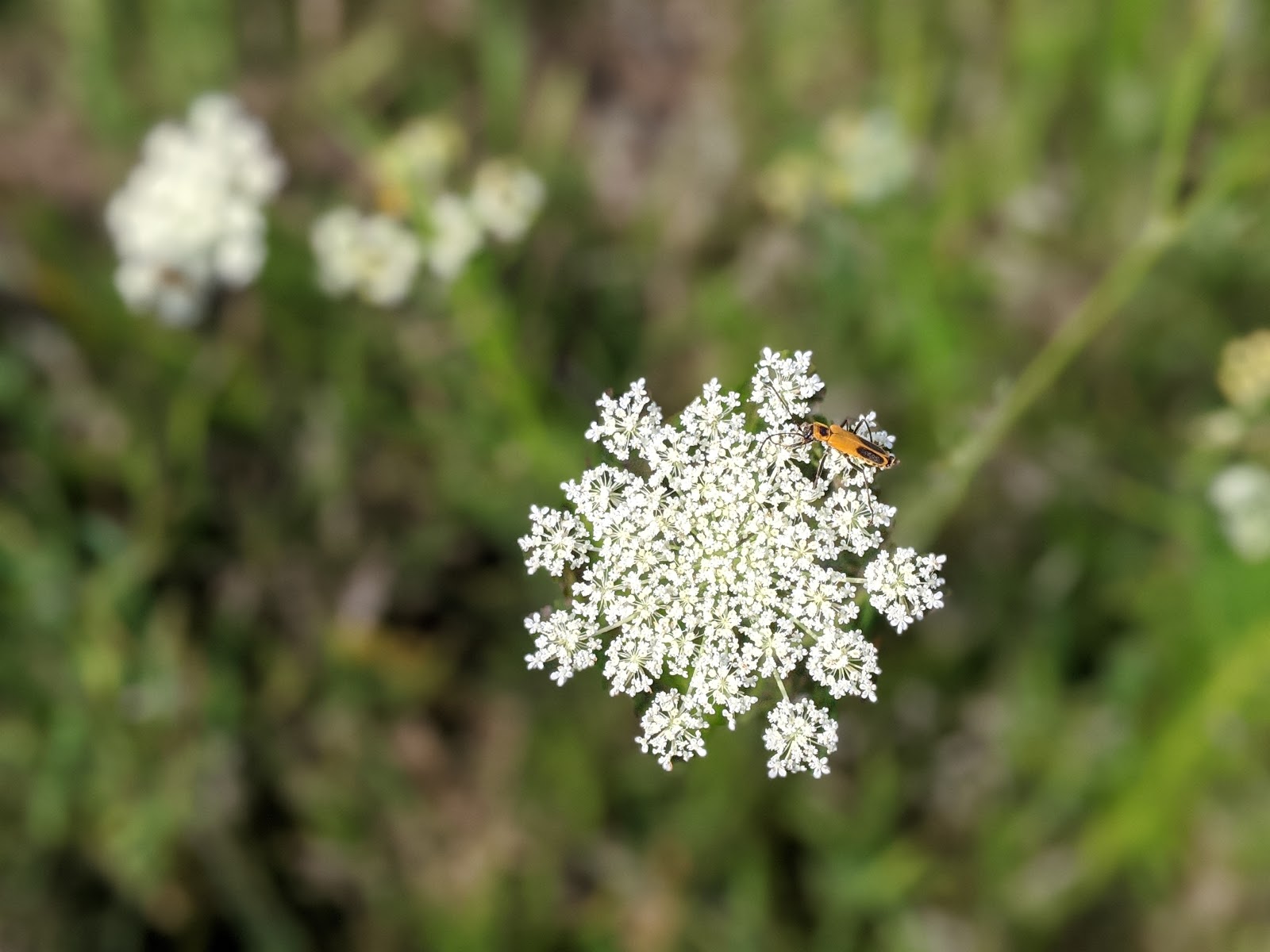
It’s late summer, so there are lots of grasshoppers. I also captured a bunch of goldenrod soldier beetles on the Queen Anne’s lace that was blooming profusely along the path. Don’t be afraid of not knowing species you see. Phones have identification abilities on them, and the app Seek is a great tool to have to track what you see and to learn more.


HINT: You can use the photos you take to draw detailed pictures in your journal at any time.


It only takes a few minutes to make it up to the top of this 25 acre park.


I sat down, opened my book, and set my timer for 20 minutes. Between the Ice Age and today, Indigenous people called this land home. I think it’s important to acknowledge that. So, I spoke out loud the following quote from therapist and trauma specialist Resmaa Menakem in his book My Grandmother’s Hands:


“I offer my respect and acknowledgement to the people who were stewards of this land long before folks from Africa and Europe made it their home.”

And then I sat and put pencil to paper. It took me a while to get into the whole process. My mind wasn't ready for NOW- it kept jumping ahead. But I did end up seeing the oak leaves at my feet, a nearby animal hole (What could have made it?), and eventually looked straight up and finally saw the awesome sky above my head. All of these could be included as journal sketches.


After time was up, I recorded my review and final thoughts. Next week, in the spirit of back-to-school, I will go to a school and explore what I can find to nature journal about. I hope to have a special guest with me- stay tuned!


Sunday, August 9, 2020

Nature Letters Journaling...Group?


I'm creating this new blog and journaling mission to encourage and challenge myself. Shall we make it a team?


This blog is going to be about exploring the natural world and journaling about it. I was inspired by John Muir Laws and Emilie Lygren's book, How to Teach Nature Journaling. It has 31 different activities listed with full breakdowns on how to teach/do them (plus variations), so there are lots of things to try.

The Goal: Walk once a week, alone or with others, do a journal entry each time, and blog about the experience. 


52 outings through all the seasons, starting Saturday, August 15 at 9:30 AM Waukesha time. The blog entries will be such that readers will be able to try things themselves at home or independently whenever they are able. 

The Needs: Every goal needs supplies.


Folks I know can join me face-to-face if they schedule ahead. Otherwise, I will record the necessary bits and post the directions for what I did for anyone to try at home. 

To study outdoors, one needs adequate clothing and footgear to walk and write in all weather. Walks will be 1-3 miles at local parks and other open spaces. We'll all need blank journals/notebooks (preferably hardcover to make outdoor writing easier) and a pencil or other tool that works in the elements and doesn't bleed through the paper. Something like this dot grid notebook would probably work. I'm going to start with a cork cover notebook a friend gave me that I only had used a few pages of. 

Besides that, a magnifying lens would be very helpful. Which reminds me...

I think electronics can be used. Phones have amazing magnification today. Tablets and pens may work in the field given the right conditions. And there are apps I'll mention that can help you identify things.

If there's more than just me there, cloth masks will be needed, of course.

Who will this be a good fit for? Anyone interested in and able to be being outdoors for 60-90 minutes and putting pen/pencil to paper for some of that time. These activities are probably best for 4th grade on up- maybe 3rd. We will hopefully see!

What is nature journaling?


Nature journaling can be about any topic one sees outside but should include words, numbers, and images. That's it! One can record things, observations, questions, feelings, or experiences. 

Why nature journaling?


Dissecting and describing experiences have always been very important to me. I dove into the world of teaching and that of living with type 1 diabetes in previous projects and wrote what I experienced, felt, and learned. I wondered what would happen if I stretched the communal artistic experience of my book about type 1 diabetes and invited others into my time outdoors? What if we all nature journal and share together? How could I and others grow through this process? Where could this exploration lead and what connections could result?

Building connections on the trail.


Because you're here reading this, we're together at the start of the trail: the trailhead. Where will the path take us? What will we see and learn about? How will we feel? How will those feelings change? Who will we find along the way? It's a mystery right now. And that's perfectly fine. In fact, it's exciting!

Let's head out now and start exploring. You, me, and the path itself...together. 

If you're interested, join me in whatever way you can: follow and read this blog which is where I will share journal entries and how-to's, or join me on the trail (email me at susan.baumgartner94@gmail.com and put "Trail Letters" in the heading and give me your contact info.) I may start a Facebook group if there's enough interest.

A Writer's Life


I'm doing this all independently as a writer and non-professional nature lover. Over time, if you find benefits and are able to support my work financially I would greatly appreciate it, but there's never a financial expectation or obligation.


Enjoy the life that's out there!